
Rocky Mountain National Park: Elevation, Reflection, and the Future of Preservation
There is a moment in Rocky Mountain National Park—often just after sunrise—when the world feels suspended between stillness and scale.
Alpine lakes mirror towering peaks. Light slowly moves across the ridgelines. The air is crisp, thin, and quiet. And in that moment, the vastness of the landscape becomes something deeply personal.
Rocky Mountain National Park is a place defined by elevation—but also by perspective.
It is where water begins, where ecosystems shift with altitude, and where preservation becomes essential to protecting not only what we see—but what lies upstream, beyond, and below.
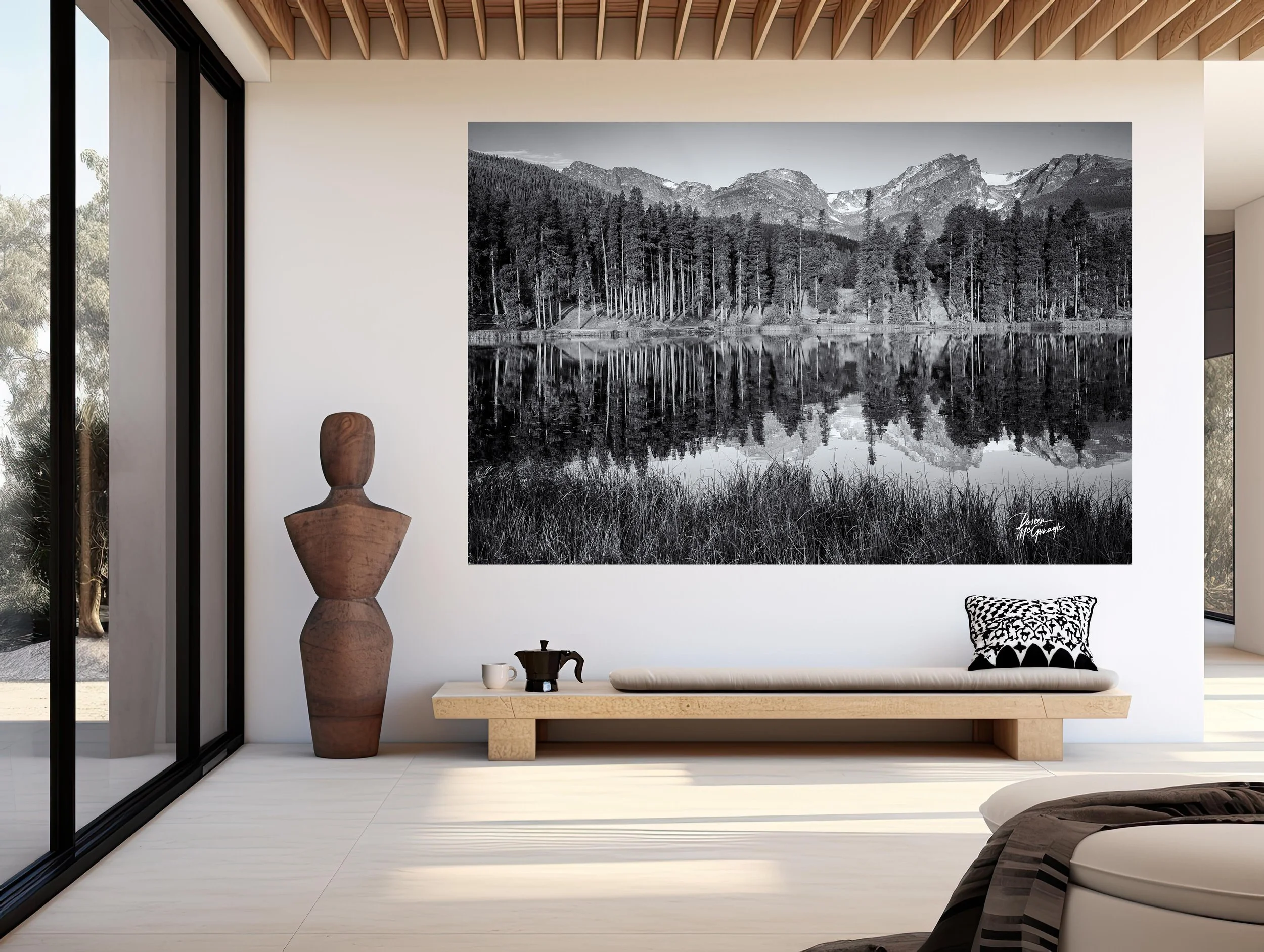
Reflected Calm at Mountain’s Edge
This landscape photography print is built on a clean, architectural rhythm. The upright trees provide a measured cadence, the water delivers perfect reflection, and the mountains supply a calm horizon—three layers in harmonious conversation. Nothing feels rushed or forced; even the grasses in the foreground offer a purposeful pause, like a soft breath before a quiet thought. The composition encourages reflection—both literal and emotional—inviting the viewer to find that steady serenity where land and sky meet.
💧 Where Water Begins
High in the Rockies, water is born.
Snowmelt feeds alpine lakes and streams, which flow downward to become rivers that sustain ecosystems far beyond the mountains. These headwaters are among the most important—and most vulnerable—resources in the country.
Everything begins here.
The clarity of alpine lakes reflects not only the sky, but the purity of the environment that sustains them. Disturbances at this elevation—whether from climate change or human impact—can ripple outward, affecting entire watersheds.
Rocky Mountain National Park reminds us that preservation starts at the source.
🏔️ Elevation and Ecosystem Diversity
Few places demonstrate ecological diversity as clearly as Rocky Mountain National Park.
As elevation increases, the landscape transforms.
Montane forests give way to subalpine ecosystems
Dense trees thin into alpine tundra
Wildlife adapts to changing conditions at each level
Above the treeline, the environment becomes harsher—wind intensifies, temperatures drop, and life becomes more specialized.
Yet even in these extreme conditions, ecosystems thrive.
This vertical diversity is one of the park’s greatest strengths—and one of its greatest vulnerabilities.
🌅 Light, Reflection, and Fine Art
Rocky Mountain National Park is a place of reflection—both literal and emotional.
At sunrise, alpine lakes become mirrors, capturing the peaks above with remarkable clarity. Light moves slowly across the landscape, revealing textures and depth that shift with every moment.
For a photographer, this is a place of balance.
The stillness of water contrasts with the scale of the mountains. The softness of light meets the strength of stone.
Through fine art photography, I aim to capture that balance—those moments when everything aligns, and the landscape feels both powerful and peaceful.
These images are not just visual—they are experiential.
They invite the viewer to step into that stillness.
🌿 A Fragile Alpine Environment
Despite its strength, Rocky Mountain National Park is fragile.
Alpine ecosystems are among the most sensitive in the world. Vegetation grows slowly, and recovery from disturbance can take decades. Wildlife depends on precise environmental conditions, and even small changes can have significant impacts.
Climate change is already affecting this landscape.
Snowpack levels are shifting. Glaciers are retreating. Water availability is changing.
These are not distant concerns—they are happening now.
Preservation here requires awareness, research, and action.
It requires us to recognize that even the most resilient landscapes have limits.
⚖️ Preservation at the Highest Level
Rocky Mountain National Park represents a critical aspect of conservation: protecting systems at their source.
Water, biodiversity, and climate all intersect in these high-altitude environments. What happens here influences everything downstream.
Preservation is not just about protecting a single park—it is about protecting interconnected systems.
This perspective is essential as we look toward the future.
Because preservation is no longer just about protecting places.
It is about protecting relationships—between land, water, and life.
🇺🇸 A Symbol for the Next 250 Years
As the United States marks its 250th anniversary, Rocky Mountain National Park stands as a powerful symbol of what we have protected—and what we must continue to protect.
It represents scale, resilience, and responsibility.
It reminds us that the most important landscapes are often the ones that sustain everything else.
And it challenges us to think beyond the present.
What will these mountains look like in 50 years?
In 100 years?
In the next 250?
The answer depends on us.
🌿 The Journey Comes Full Circle
From the flowing waters of the Everglades…
To the carved stone of the Southwest…
To the reflective stillness of alpine lakes…
This Parks & Preservation journey reveals a single, unifying truth:
Every landscape is connected.
Water flows.
Light shifts.
Ecosystems evolve.
And through it all, preservation remains the constant.
Rocky Mountain National Park brings that journey full circle—returning us to the source, to the beginning, and to the responsibility we share moving forward.
✨ Call to Action
If the beauty and significance of Rocky Mountain National Park—and the landscapes throughout this series—have inspired you, I invite you to take the next step.
📖 Pre-order the Parks & Preservation book, where fine art photography and storytelling come together to explore America’s most extraordinary landscapes and the importance of protecting them.
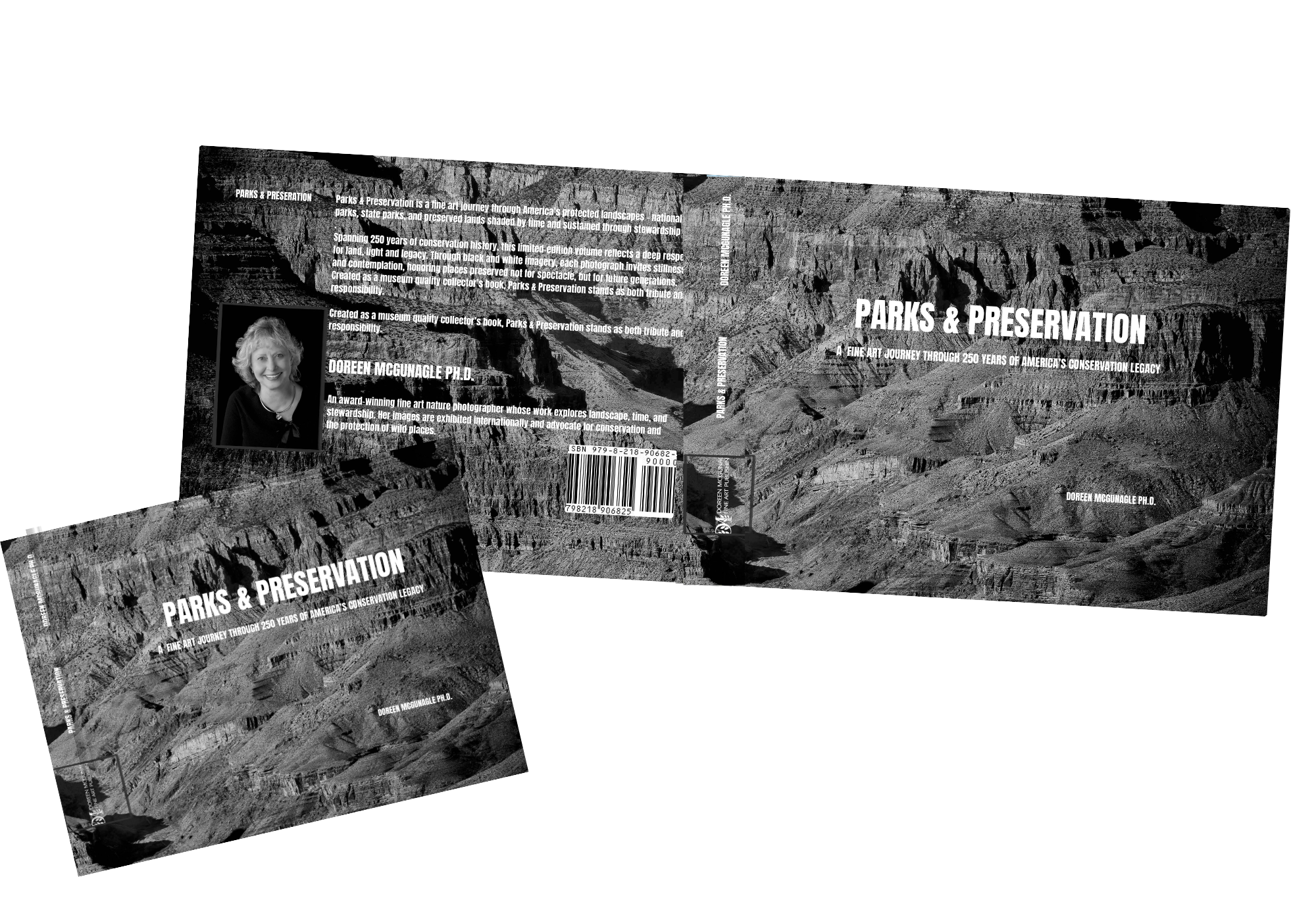
Parks & Preservation — First Edition (Signed Collector Copy)
Created in recognition of the 250th Anniversary of the United States, this volume reflects on preservation as both a civic responsibility and a form of generational stewardship. Through carefully composed imagery emphasizing form, light, and permanence, the collection honors America’s protected landscapes as enduring symbols of shared heritage and environmental responsibility.
🌍 Support Global Voices for Nature Foundation Inc., dedicated to advancing conservation through photography, education, and storytelling—helping preserve these ecosystems for generations to come.
Together, we can ensure that places like Rocky Mountain National Park remain—elevated, protected, and enduring—for the next 250 years and beyond.