
We are accustomed to seeing photographs small.
They appear on phones, tablets, websites, and social media feeds—often for only a few seconds before we move to the next image.
Fine art photography asks us to experience an image differently.
And scale can completely transform that experience.
From Looking at a Photograph to Entering It
When an aerial photograph is presented at 40 × 60 inches, the relationship between viewer and image changes.
Details emerge.
Patterns become visible.
Textures that disappeared on a screen suddenly become important.
The viewer can step closer to examine a small section and then move backward to experience the entire composition.
Large-scale photography becomes almost architectural.
It occupies space rather than merely decorating it.
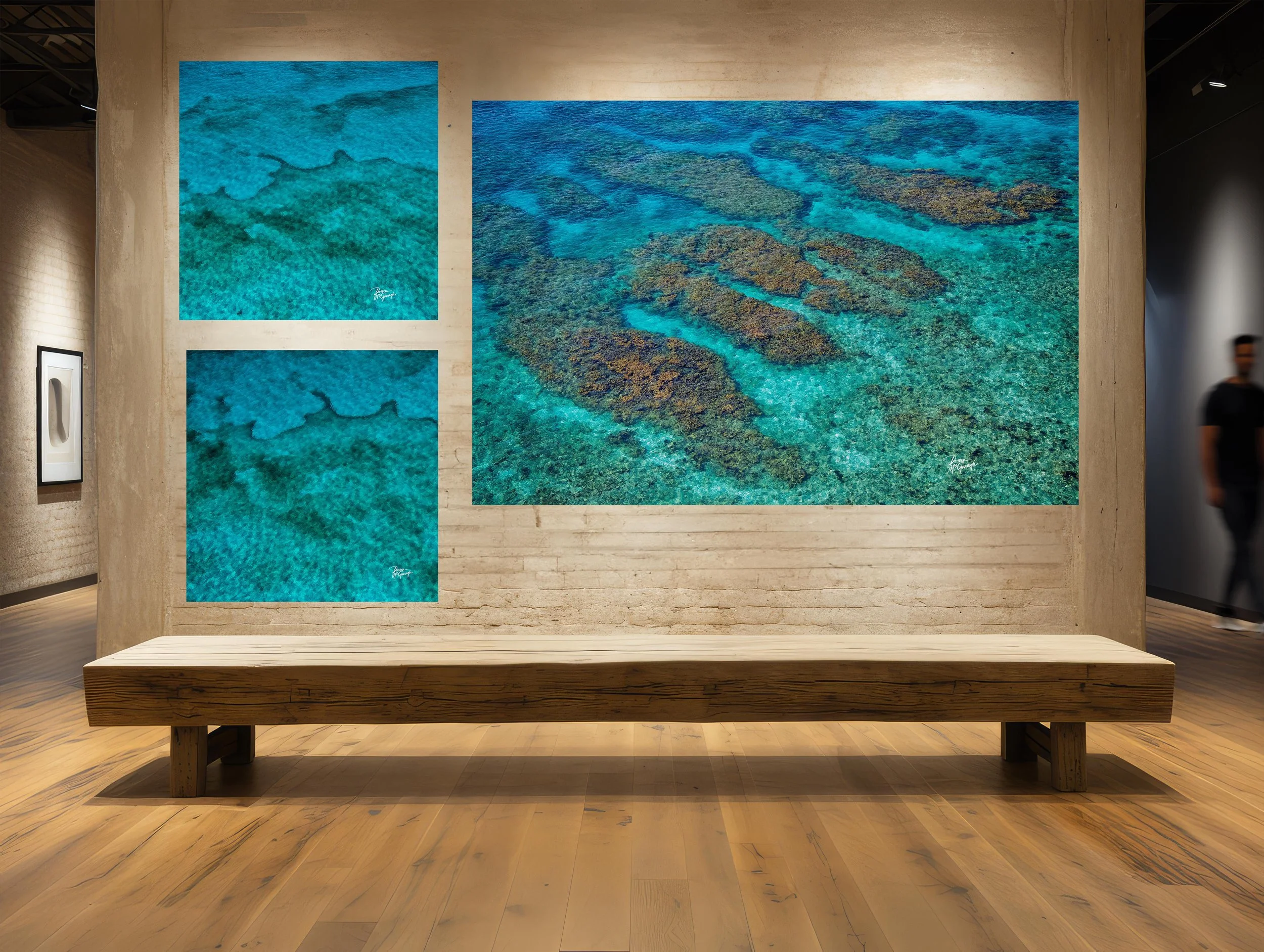
When Scale Changes the Experience
At large scale, an aerial photograph becomes more than an image on a wall. The intricate formations, variations in water, and natural patterns of Looe Key begin to unfold, allowing the viewer to experience the reef with a greater sense of depth and immersion.
Aerial Photography Needs Room
My recent aerial work is particularly suited to larger formats.
Consider a coral reef photographed from above.
On a phone, the viewer may notice turquoise water and an attractive pattern.
At large scale, individual reef formations become visible. Channels appear between structures. Changes in water depth create subtle tonal variations.
The photograph begins to reveal the complexity of the ecosystem.
The same is true of kelp forests, coastlines, deserts, mountains, and glaciers.
Scale allows the landscape to unfold.
Choosing the Right Size
Larger is not automatically better.
Artwork needs to relate to its environment.
A 24 × 36-inch photograph may be ideal for an intimate room or a grouping.
A 30 × 45-inch piece provides greater visual presence.
A 40 × 60-inch photograph can become a significant focal point.
The goal should be to create enough visual breathing room around the artwork that it can be experienced comfortably.
Collectors sometimes underestimate how well a larger artwork can work on a substantial wall.
A single powerful piece can often create a cleaner and more intentional environment than several smaller objects competing for attention.

Mosaic Currents of Looe Key
Mosaic Currents of Looe Key offers an immersive glimpse into the delicate vitality of an underwater coral reef, seen from an elevated aerial perspective. Suspended between documentation and abstraction, this fine art nature photography piece reveals a living tapestry shaped by water, light, and time. Captured within the protected waters of the Florida Keys National Marine Sanctuary, the image transforms the reef into an expansive composition where natural patterns unfold like a mosaic — each element distinct, yet intrinsically connected to a greater whole. Through the lens of abstract realism, the photograph invites viewers to slow down and experience the ocean not only as a landscape but as a living, breathing system.
Material Changes the Experience Too
Size is only one consideration.
Presentation materials influence how a photograph interacts with light and space.
Metal PRO works particularly well with many of my aerial water images because of its clarity and luminosity.
Acrylic PRO creates depth and a sophisticated contemporary presentation.
Canvas PRO can soften the photographic surface and emphasize the painterly quality of abstract natural forms.
There is no single correct choice.
The right presentation depends upon the photograph, the room, available light, and the experience the collector wants to create.
Living with Nature Through Art
One reason people are drawn to landscape and nature photography is that it provides a visual connection to environments beyond our everyday surroundings.
A mountain landscape can bring a sense of expansiveness into an urban home.
An aerial ocean image can introduce movement and tranquility.
A wildlife photograph can recall a meaningful encounter or journey.
At larger scale, that connection becomes stronger.
The artwork is no longer simply something on the wall.
It becomes part of the atmosphere of the room.
Art with a Larger Purpose
For me, the experience does not end when an artwork enters a collector's home.
A portion of purchases from Doreen McGunagle Fine Art supports Global Voices for Nature Foundation Inc., a 501(c)(3) nonprofit dedicated to conservation education and awareness.
The Foundation's mission reflects the same idea that guides my photography: meaningful connections with nature can begin with seeing.
Sometimes that begins in a national park.
Sometimes from a helicopter.
And sometimes it begins with a photograph on a wall that makes someone stop, look closer, and ask about the place it represents.