
Why Black-and-White Nature Photography Still Matters
Color is one of nature’s most immediate attractions.
The turquoise of tropical water, brilliant greens of wetlands, warm desert stone, and changing colors of mountain landscapes can be extraordinary.
Yet sometimes removing color reveals more.
Black-and-white photography asks the viewer to pay attention to light, texture, form, contrast, atmosphere, and emotion. Without color directing the eye, the structure of a landscape becomes more visible.
For this reason, monochrome photography continues to play an important role in my fine art practice.
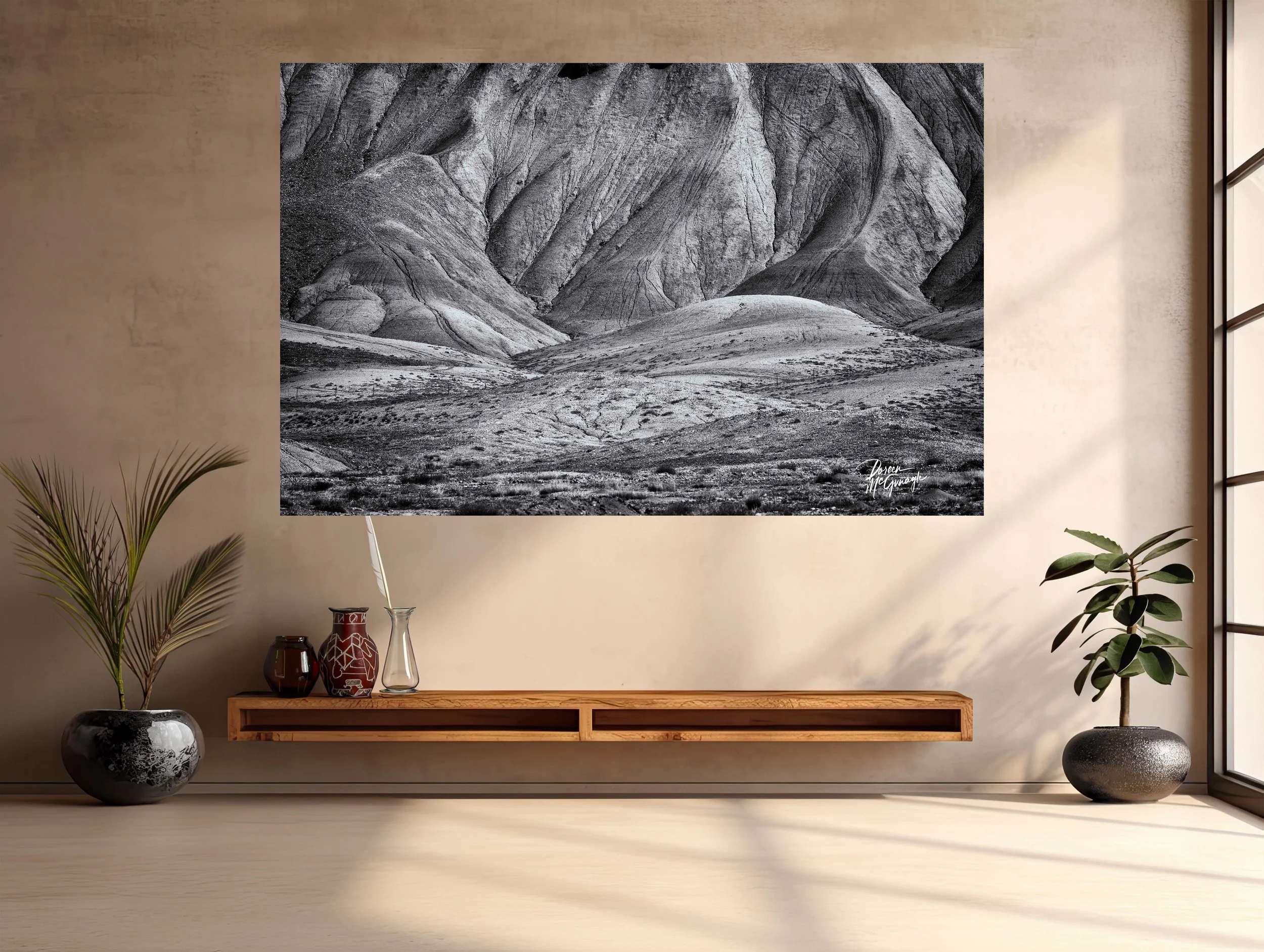
Contours Beneath the Frame
A striking statement for design-forward interiors. As large wall art, Contours Beneath the Frame lends presence without visual clutter—ideal for contemporary, minimalist, Japandi, and modern rustic spaces. The image’s strong lines harmonize with architectural details like exposed beams, concrete, steel, and natural wood. Hang it above a console, sofa, or credenza to anchor a living room; place it in an entryway for a dramatic first impression; or use it as a focal point in dining rooms and primary bedrooms. Its neutral palette layers seamlessly with limewash or matte walls, textured linens, ceramic accents, and warm wood tones.
Beyond the Absence of Color
A successful black-and-white photograph is not simply a color image with its saturation removed.
The image must work differently.
Light becomes essential. Shadows become compositional elements. Texture carries greater visual weight.
Fog can simplify an entire landscape.
Rock formations become sculptural.
Trees become lines and gestures.
Water becomes tonal movement rather than color.
The result can feel timeless.
National Parks in Monochrome
Many photographs in my Parks & Preservation body of work lend themselves naturally to black and white.
America’s national and state parks contain landscapes defined by geology, weather, scale, and time.
In monochrome, those characteristics often become more pronounced.
A mountain does not need color to communicate its scale.
A canyon does not need a blue sky to reveal its layers.
Fog moving through a forest may actually become more expressive once color is removed.
This approach also connects contemporary photography with the long history of landscape photography and conservation in the United States.
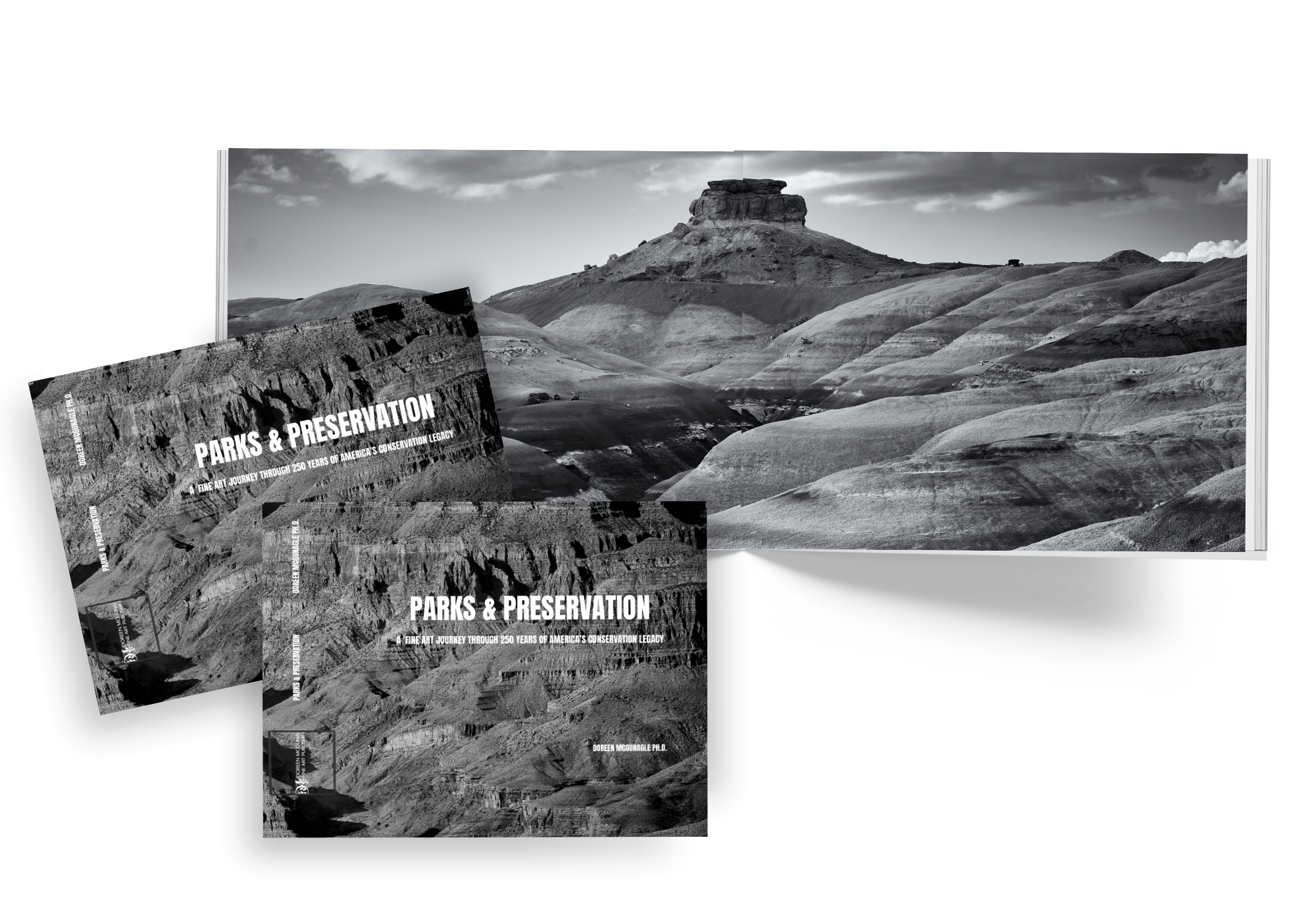
Parks & Preservation: A Fine Art Journey through 250 Years of America’s Conservation Legacy
Through carefully composed black-and-white imagery, the collection reflects on preservation not simply as admiration of beauty, but as a civic commitment carried forward across generations.
Parks & Preservation
That relationship is explored more deeply in my book, Parks & Preservation: A Fine Art Journey Through 250 Years of America’s Conservation Legacy.
Created as a black-and-white fine art monograph, the book brings together photographs from protected landscapes while examining the broader idea of preservation.
The First Edition is limited to 250 signed copies and was designed as both an art object and a visual reflection on conservation.
The absence of color gives the photographs a visual continuity despite the enormous differences among the landscapes represented.
Mountains, deserts, wetlands, coastlines, forests, and geological formations become chapters in one larger American story.
Choosing Between Color and Black and White
I am often asked how I determine whether an image should remain in color or become monochrome.
There is no formula.
I look at what is essential to the photograph.
If color is central to understanding the ecosystem—as it often is with coral reefs or turquoise coastal water—color may be fundamental to the image.
But when structure, atmosphere, light, or texture carries the story, black and white can remove distraction and reveal the photograph's underlying architecture.
The decision is ultimately about what allows the landscape to speak most clearly.
A Different Kind of Stillness
Black-and-white photographs can also create a different emotional experience in an interior.
They are quiet without being passive.
They can anchor a room while allowing the viewer to continually discover details.
More importantly, they resist trends.
A powerful monochrome landscape can feel contemporary and historical at the same time.
For collectors, that timeless quality is part of the appeal of black-and-white fine art photography.
For me as an artist, however, the attraction remains simpler.
Removing color allows me to ask: what is left?
Light.
Form.
Texture.
Place.
And sometimes that is precisely enough.
Photography with a Conservation Purpose
A portion of purchases from Doreen McGunagle Fine Art supports Global Voices for Nature Foundation Inc., a 501(c)(3) nonprofit organization dedicated to conservation education and awareness.
Through photography and environmental storytelling, the Foundation works to strengthen the connection between people and the natural places that surround us.
Whether photographed in brilliant color or quiet monochrome, these landscapes carry the same message: what we choose to notice is more likely to become what we choose to value.