8136-41
Fractured Tides Above the Shore captures the restless boundary between land and sea, revealing from above a coastal landscape shaped by repetition, resistance, and perpetual change. Photographed from a helicopter along the San Diego coastline, the image isolates a dark rock within a field of deep green, turquoise, and white water. Around it, waves advance, fracture, curl, and retreat, leaving behind branching patterns that exist for only seconds before the Pacific creates them anew.
From the air, the familiar act of a wave meeting the shore becomes something entirely different.
The horizon disappears. There is no sweeping coastal vista to establish a conventional sense of place. Instead, the viewer is brought directly into the interaction between water and stone. The ocean fills the frame, and scale becomes uncertain. What might ordinarily be perceived simply as surf begins to resemble a network of veins, tributaries, roots, or branching pathways.
These fractal-like patterns are among the most compelling visual characteristics of the natural world.
Fractals are associated with forms in which similar structures or patterns recur across different scales. Nature rarely produces the mathematical perfection of an idealized fractal, yet fractal characteristics appear throughout landscapes—in branching trees and river systems, coastlines, clouds, mountain formations, and the constantly changing edges created where water encounters land.
In Fractured Tides Above the Shore, that visual language is written in water.
White foam branches across darker passages of the Pacific, separating and reconnecting as waves encounter the irregular contours beneath them. Larger sweeping forms divide into smaller channels; those channels fragment again into increasingly delicate lines. For a brief moment, an intricate network appears across the surface before movement dissolves it.
The pattern is simultaneously structured and unpredictable.
At the center of this movement, the solitary dark rock provides an essential counterpoint. It appears stable and enduring while everything surrounding it is fluid. Water rushes toward it, divides around it, and continues beyond it. Waves repeatedly obscure portions of its form before withdrawing and revealing the rock once again.
That relationship creates the tension at the heart of the photograph: permanence against impermanence, resistance against flow, stillness within motion.
Yet even the apparent permanence of stone is relative.
The same water that seems merely to move around the rock is also part of the process that continually reshapes coastlines. Wave after wave, tide after tide, the Pacific interacts with the geological structures at its edge. Changes may be imperceptible within a single moment, but accumulated across time they become part of the architecture of the coast itself.
The rock therefore becomes more than a visual anchor. It represents a different measure of time.
The water changes in seconds.
The shoreline changes across years, decades, and centuries.
The photograph brings those timescales together within one frame.
Color strengthens this relationship. Deep green passages suggest greater depth and density, while luminous turquoise areas reveal the influence of light and shallower water. Across these rich tones, white surf traces temporary boundaries with remarkable clarity. The foam becomes almost graphic—an intricate network of luminous lines moving through the composition.
Viewed from a distance, Fractured Tides Above the Shore can be experienced as abstraction. Turquoise, green, black, and white create an arrangement of color and form with little immediate indication of scale. The dark rock might be a mark of pigment; the surrounding foam could be cracks in stone, veins in marble, or branching forms seen through a microscope.
Only gradually does the coastal reality become apparent.
This movement between recognition and abstraction is central to my exploration of aerial abstract realism. The landscape itself creates the composition. Nothing is staged, rearranged, or invented. Instead, altitude removes the visual references that normally tell us what we are seeing and allows naturally occurring patterns to take precedence.
The aerial perspective is particularly powerful along coastlines because coastlines are not fixed lines.
From a map, the boundary between land and ocean can appear definite. From above, it becomes something far more complex—a shifting transitional zone shaped by tides, waves, geological formations, wind, currents, and time. Water reaches across rock and then withdraws. Foam briefly defines an edge only to erase it moments later.
The boundary is continually being rewritten.
That process connects Fractured Tides Above the Shore to the broader San Diego aerial series. While the kelp works reveal patterns formed within a living underwater forest, the fractal images turn attention toward the physical forces shaping the coastline itself. Together, they explore different manifestations of a common idea: nature creates order through movement, repetition, and interconnected processes.
There is something especially compelling about recognizing these patterns from the air. What appears chaotic at eye level can reveal an unexpected organization when viewed from a greater distance. The aerial perspective does not simplify nature; instead, it exposes another layer of its complexity.
Fractured Tides Above the Shore captures only one instant within that process.
The wave patterns recorded in the photograph no longer exist. The foam dispersed, another wave arrived, and an entirely new network formed around the rock. The next tide would alter the water level, the next change in light would transform the color, and the Pacific would continue creating and erasing its own compositions.
The photograph preserves one of them.
Within that fleeting geometry is a reminder that some of nature's most extraordinary patterns are also its most temporary. They emerge through the interaction of forces rather than through permanence, appearing long enough to be witnessed before becoming something else.
From high above the San Diego coastline, Fractured Tides Above the Shore transforms the meeting of ocean and stone into a meditation on resilience, change, and natural order. The solitary rock holds its place while water divides and reconnects around it, creating fractal-like pathways that echo patterns found throughout the natural world.
It is both landscape and abstraction, stillness and movement—a fleeting record of the Pacific continuously drawing, fracturing, and redrawing the edge of the shore.
A portion of proceeds supports Global Voices for Nature Foundation Inc., helping advance conservation and education through photography.
8136-41
Fractured Tides Above the Shore captures the restless boundary between land and sea, revealing from above a coastal landscape shaped by repetition, resistance, and perpetual change. Photographed from a helicopter along the San Diego coastline, the image isolates a dark rock within a field of deep green, turquoise, and white water. Around it, waves advance, fracture, curl, and retreat, leaving behind branching patterns that exist for only seconds before the Pacific creates them anew.
From the air, the familiar act of a wave meeting the shore becomes something entirely different.
The horizon disappears. There is no sweeping coastal vista to establish a conventional sense of place. Instead, the viewer is brought directly into the interaction between water and stone. The ocean fills the frame, and scale becomes uncertain. What might ordinarily be perceived simply as surf begins to resemble a network of veins, tributaries, roots, or branching pathways.
These fractal-like patterns are among the most compelling visual characteristics of the natural world.
Fractals are associated with forms in which similar structures or patterns recur across different scales. Nature rarely produces the mathematical perfection of an idealized fractal, yet fractal characteristics appear throughout landscapes—in branching trees and river systems, coastlines, clouds, mountain formations, and the constantly changing edges created where water encounters land.
In Fractured Tides Above the Shore, that visual language is written in water.
White foam branches across darker passages of the Pacific, separating and reconnecting as waves encounter the irregular contours beneath them. Larger sweeping forms divide into smaller channels; those channels fragment again into increasingly delicate lines. For a brief moment, an intricate network appears across the surface before movement dissolves it.
The pattern is simultaneously structured and unpredictable.
At the center of this movement, the solitary dark rock provides an essential counterpoint. It appears stable and enduring while everything surrounding it is fluid. Water rushes toward it, divides around it, and continues beyond it. Waves repeatedly obscure portions of its form before withdrawing and revealing the rock once again.
That relationship creates the tension at the heart of the photograph: permanence against impermanence, resistance against flow, stillness within motion.
Yet even the apparent permanence of stone is relative.
The same water that seems merely to move around the rock is also part of the process that continually reshapes coastlines. Wave after wave, tide after tide, the Pacific interacts with the geological structures at its edge. Changes may be imperceptible within a single moment, but accumulated across time they become part of the architecture of the coast itself.
The rock therefore becomes more than a visual anchor. It represents a different measure of time.
The water changes in seconds.
The shoreline changes across years, decades, and centuries.
The photograph brings those timescales together within one frame.
Color strengthens this relationship. Deep green passages suggest greater depth and density, while luminous turquoise areas reveal the influence of light and shallower water. Across these rich tones, white surf traces temporary boundaries with remarkable clarity. The foam becomes almost graphic—an intricate network of luminous lines moving through the composition.
Viewed from a distance, Fractured Tides Above the Shore can be experienced as abstraction. Turquoise, green, black, and white create an arrangement of color and form with little immediate indication of scale. The dark rock might be a mark of pigment; the surrounding foam could be cracks in stone, veins in marble, or branching forms seen through a microscope.
Only gradually does the coastal reality become apparent.
This movement between recognition and abstraction is central to my exploration of aerial abstract realism. The landscape itself creates the composition. Nothing is staged, rearranged, or invented. Instead, altitude removes the visual references that normally tell us what we are seeing and allows naturally occurring patterns to take precedence.
The aerial perspective is particularly powerful along coastlines because coastlines are not fixed lines.
From a map, the boundary between land and ocean can appear definite. From above, it becomes something far more complex—a shifting transitional zone shaped by tides, waves, geological formations, wind, currents, and time. Water reaches across rock and then withdraws. Foam briefly defines an edge only to erase it moments later.
The boundary is continually being rewritten.
That process connects Fractured Tides Above the Shore to the broader San Diego aerial series. While the kelp works reveal patterns formed within a living underwater forest, the fractal images turn attention toward the physical forces shaping the coastline itself. Together, they explore different manifestations of a common idea: nature creates order through movement, repetition, and interconnected processes.
There is something especially compelling about recognizing these patterns from the air. What appears chaotic at eye level can reveal an unexpected organization when viewed from a greater distance. The aerial perspective does not simplify nature; instead, it exposes another layer of its complexity.
Fractured Tides Above the Shore captures only one instant within that process.
The wave patterns recorded in the photograph no longer exist. The foam dispersed, another wave arrived, and an entirely new network formed around the rock. The next tide would alter the water level, the next change in light would transform the color, and the Pacific would continue creating and erasing its own compositions.
The photograph preserves one of them.
Within that fleeting geometry is a reminder that some of nature's most extraordinary patterns are also its most temporary. They emerge through the interaction of forces rather than through permanence, appearing long enough to be witnessed before becoming something else.
From high above the San Diego coastline, Fractured Tides Above the Shore transforms the meeting of ocean and stone into a meditation on resilience, change, and natural order. The solitary rock holds its place while water divides and reconnects around it, creating fractal-like pathways that echo patterns found throughout the natural world.
It is both landscape and abstraction, stillness and movement—a fleeting record of the Pacific continuously drawing, fracturing, and redrawing the edge of the shore.
A portion of proceeds supports Global Voices for Nature Foundation Inc., helping advance conservation and education through photography.

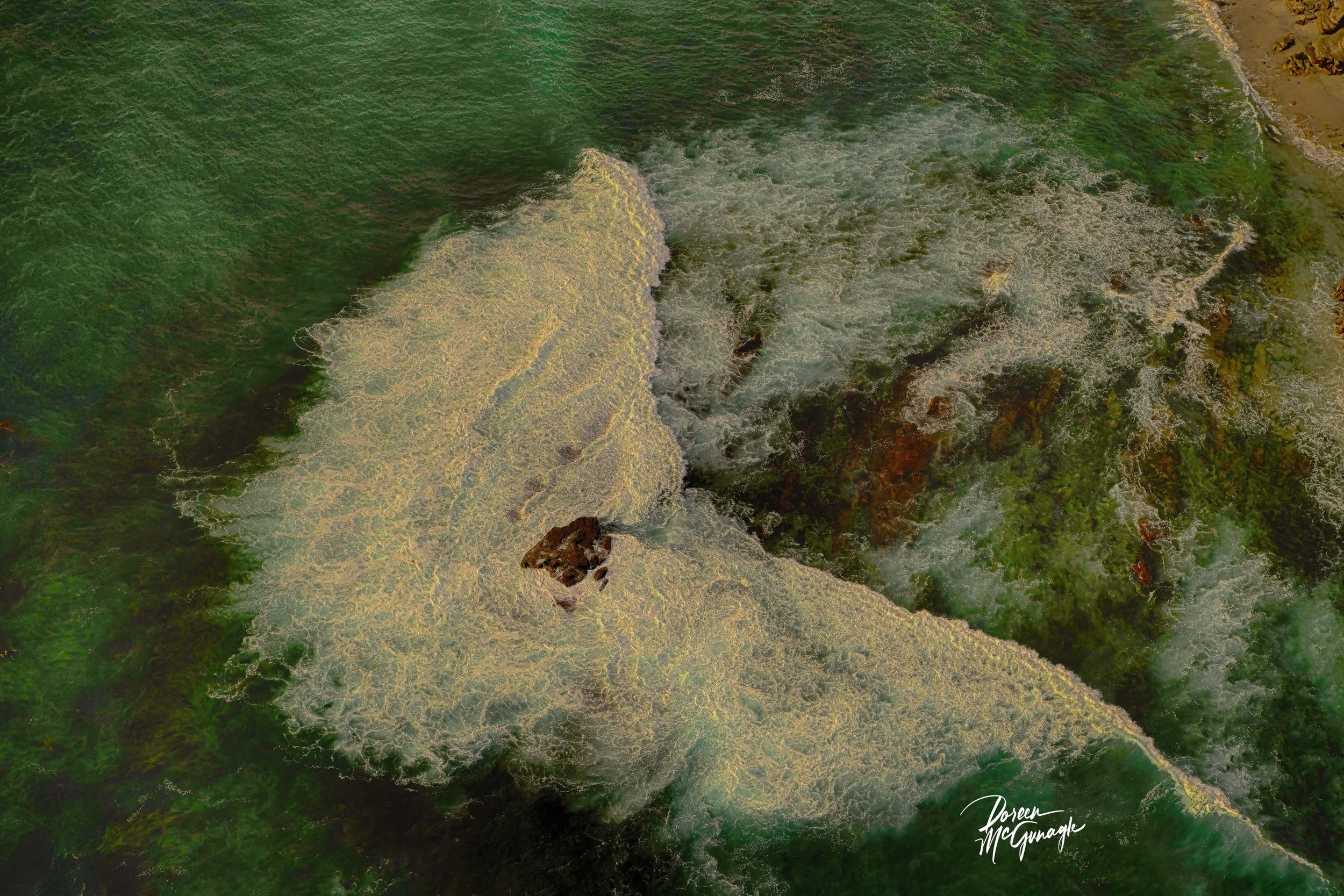 Image 1 of 4
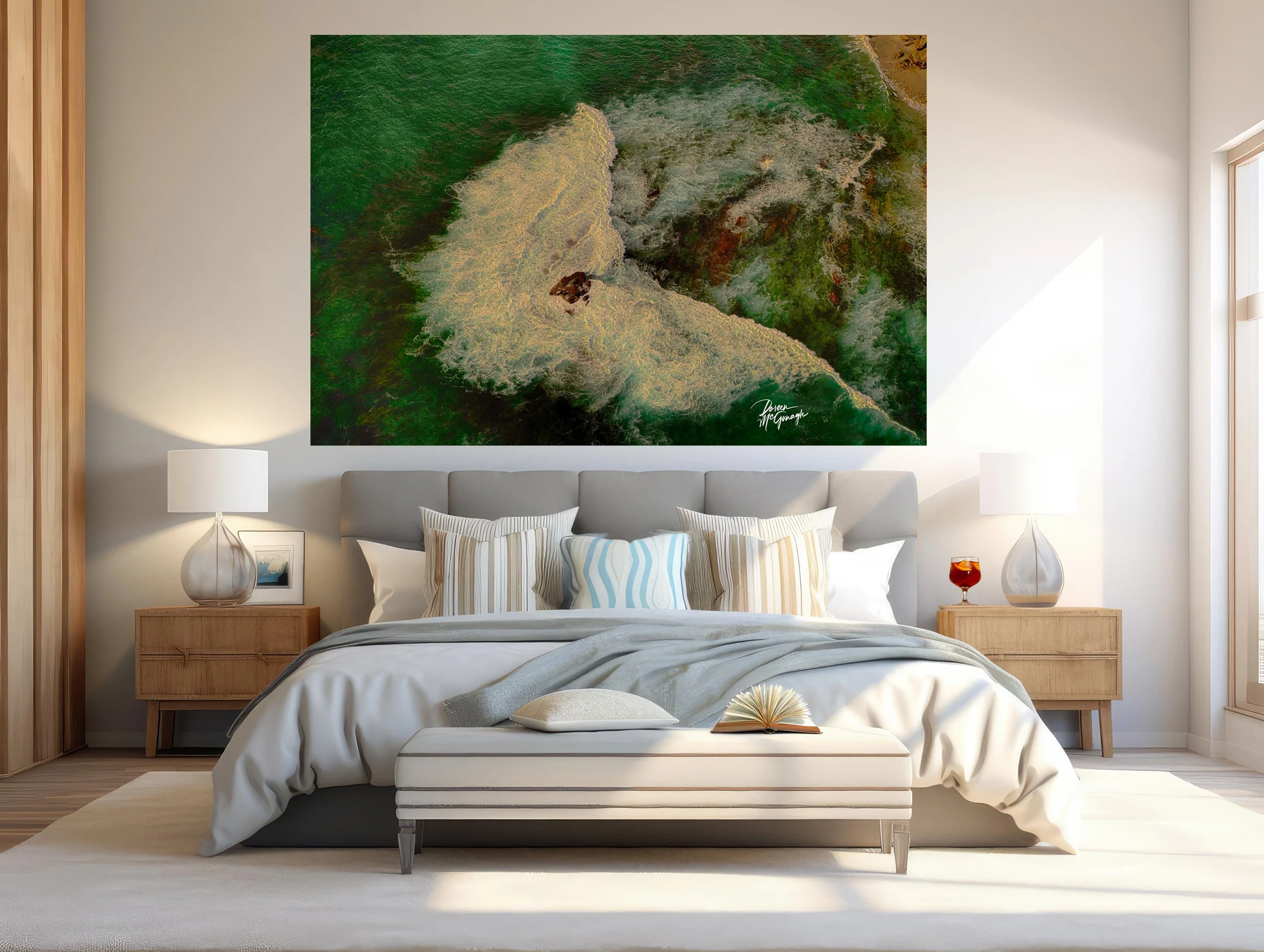 Image 2 of 4
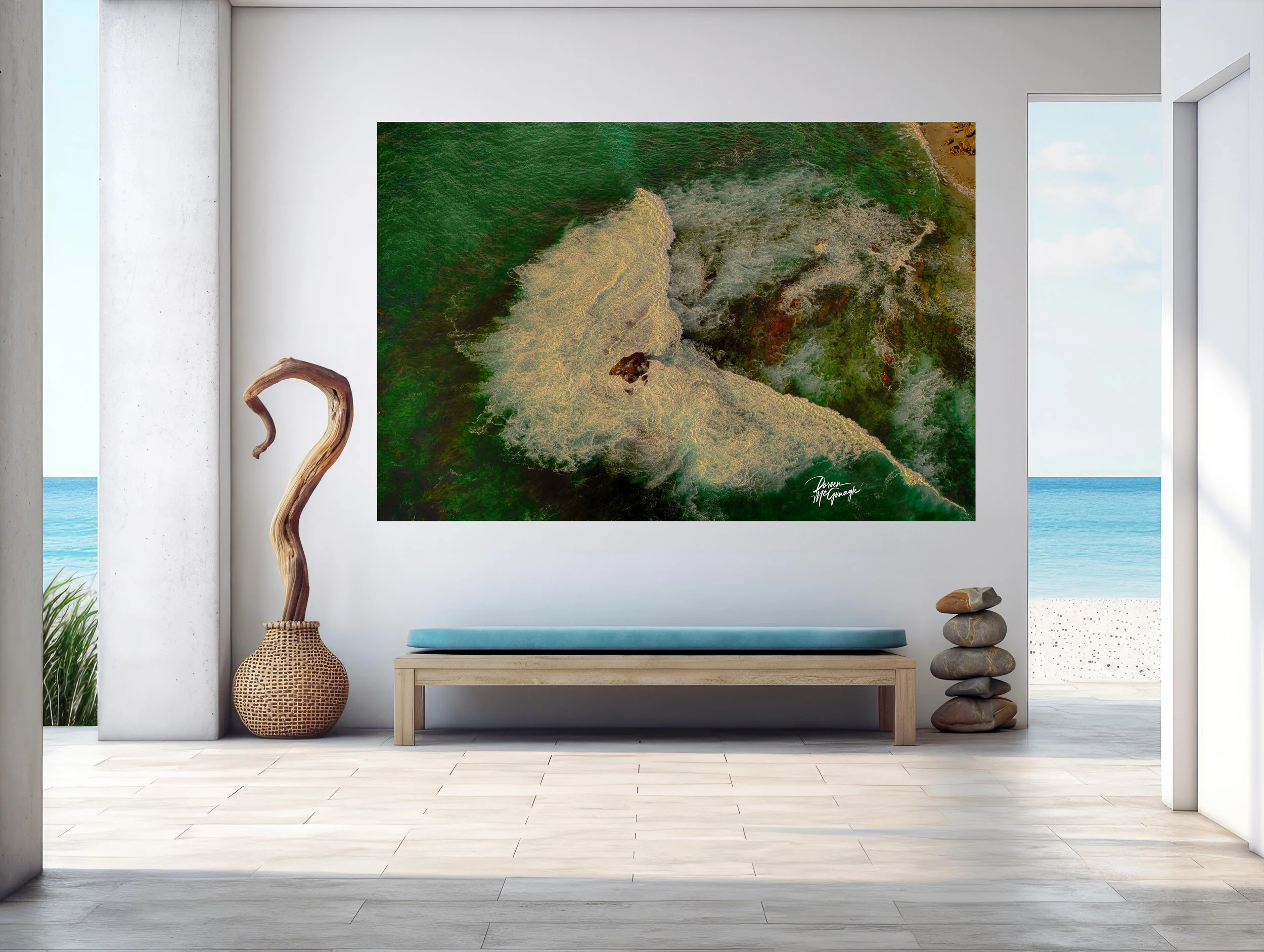 Image 3 of 4
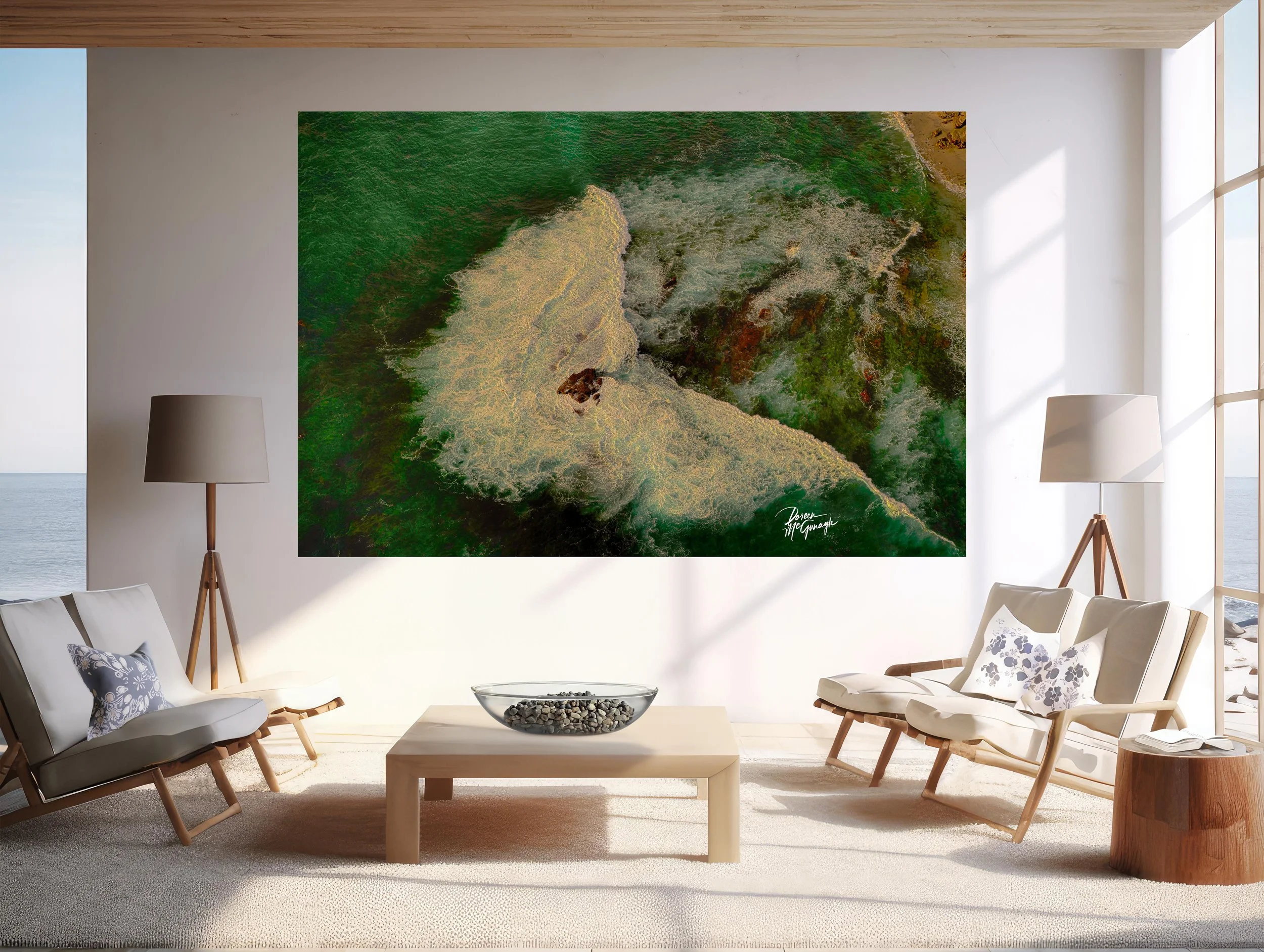 Image 4 of 4