
From Landscape to Aerial Realism: Seeing Nature from a New Perspective
For years, my fine art photography has been shaped by one central question: how can a photograph invite us to see the natural world differently?
Sometimes the answer is found standing quietly before a mountain, watching fog move through a valley or waiting for wildlife to emerge from the landscape. Increasingly, however, I have found another answer thousands of feet above the earth.
Aerial photography has transformed the way I see nature.
From above, familiar landscapes become unfamiliar. Coastlines turn into sweeping gestures. Reefs resemble intricate paintings. Kelp forests create organic patterns beneath turquoise water. Waves become repeating lines, while sand, stone, vegetation, and water form compositions that seem almost intentionally designed.
This perspective lies at the heart of what I call Aerial Abstract Realism.
When Photography Begins to Look Like Painting
The landscapes in my aerial photographs are real. The colors, textures, lines, and patterns existed when the photograph was taken. Yet removing the conventional horizon changes how we understand what we are seeing.
Scale becomes uncertain.
A reef can resemble a branching tree. A breaking wave can become a brushstroke. Kelp floating beneath the Pacific can appear like veins running through stone.
The photograph remains grounded in a real ecosystem, but the visual experience moves toward abstraction.
That tension between documentation and abstraction fascinates me.
From the Florida Keys to the Pacific Coast
My recent aerial work has taken me above two very different marine environments.
Over Looe Key in the Florida Keys, coral formations emerged beneath translucent water as extraordinary natural patterns. These images became the foundation for The Living Blueprint: Florida Keys — Abstract Realism from the Air.
More recently, I photographed the Pacific coastline near San Diego, including kelp forests, coastal formations, waves, and tidal environments.
The two locations could hardly be more different.
Yet viewed from the air, they share a visual language.
Water connects them. Movement connects them. Fragility connects them.
Each ecosystem also tells a larger environmental story.
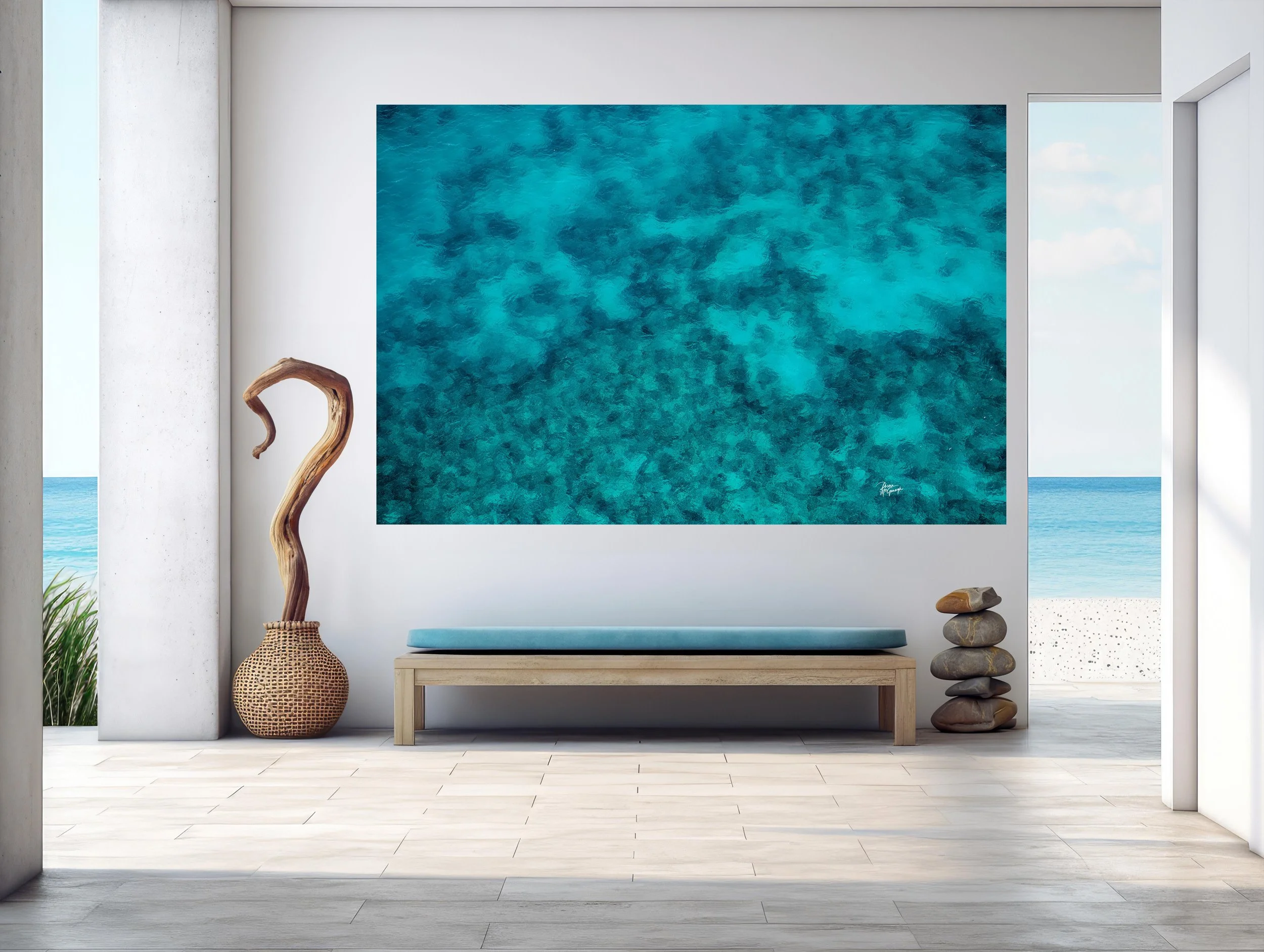
Turquoise Veins of Hidden Eden
The photograph’s power lies in its balance between definition and abstraction. While the underlying structures remain rooted in reality, the shifting patterns and tonal gradients invite interpretation beyond literal observation. The coral formations become painterly gestures, the water surface a translucent veil that both reveals and conceals. This tension between visibility and concealment draws viewers into the image emotionally, prompting reflection on the hidden ecosystems that exist just beyond everyday perception. Through abstract realism, the work encourages an appreciation for nature’s subtle complexity rather than its obvious spectacle.
Art as an Invitation to Look Longer
Fine art nature photography can do something that scientific information alone sometimes cannot: create an emotional connection.
A viewer may initially be drawn to an aerial photograph because of its composition or color. Only afterward do they discover that the abstract pattern is actually a coral reef or kelp forest.
That moment of recognition matters.
It transforms the photograph from something visually beautiful into something connected to a real place.
My goal is not simply to document landscapes. It is to encourage viewers to slow down, become curious, and consider the ecosystems represented within the image.
The Continuing Evolution
Aerial photography is now becoming an increasingly important part of my artistic practice.
The work will be featured in my upcoming solo exhibition, Edges of the Earth: Fragile Ecosystems from Reef to Glacier, opening at the Cornell Art Museum in Delray Beach in April 2027.
The exhibition will bring together imagery from the Florida Keys, San Diego's Pacific coastline, and Greenland’s Ilulissat Icefjord.
From reef to glacier, each environment reveals something different about the relationship between water, geology, climate, and time.
Viewed individually, the photographs capture remarkable places.
Viewed together, they tell a much larger story about our interconnected natural world.
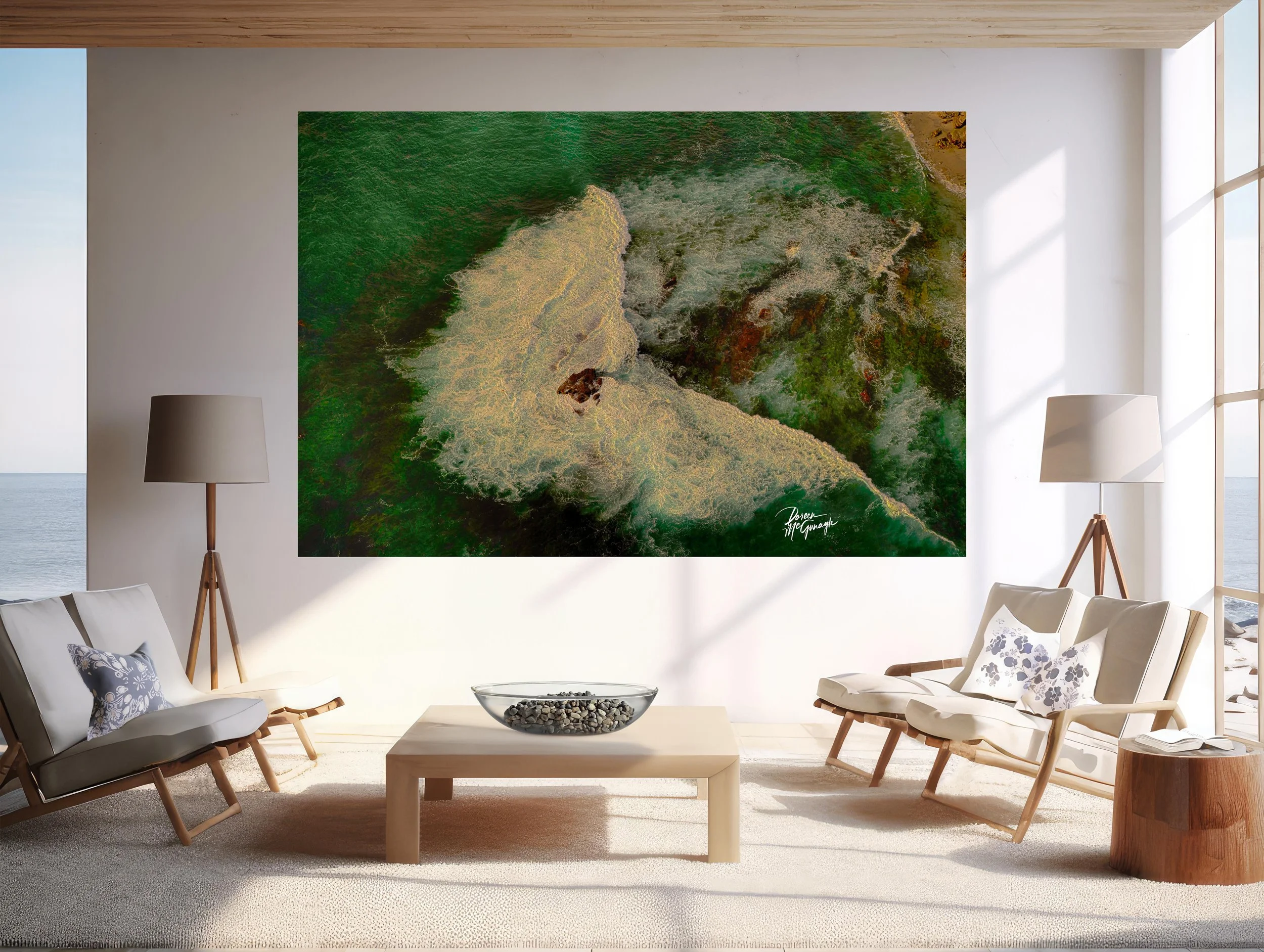
Fractured Tides Above the Shore
In Fractured Tides Above the Shore, that visual language is written in water.
White foam branches across darker passages of the Pacific, separating and reconnecting as waves encounter the irregular contours beneath them. Larger sweeping forms divide into smaller channels; those channels fragment again into increasingly delicate lines. For a brief moment, an intricate network appears across the surface before movement dissolves it.
The pattern is simultaneously structured and unpredictable.
Art Supporting Conservation
My photography is increasingly connected to a larger purpose beyond the finished artwork.
A portion of purchases from Doreen McGunagle Fine Art supports Global Voices for Nature Foundation Inc., a 501(c)(3) nonprofit organization dedicated to conservation education and increasing awareness of the importance of protecting our natural resources.
Through fine art, photography, educational storytelling, and conservation initiatives, the Foundation helps people develop a deeper connection with the natural world.
Every artwork begins with a place worth seeing.
And many of those places are also worth protecting.